
Table of Contents
ToggleAI Is Your New Customer: The B2AI Advantage for Oil & Gas Companies
Why the next competitive advantage begins with an AI-optimized website
A year ago, I wrote about what I called the B2AI Advantage in Oil & Gas—the shift from marketing only business-to-business to also communicating business-to-artificial intelligence.
At the time, the idea was simple: AI would increasingly stand between a company and the people researching its products, services, and expertise.
After tracking how AI-powered search has evolved, that shift is no longer theoretical. It is happening now.
AI platforms are increasingly summarizing information before a buyer visits a website. They are helping engineers understand technologies, procurement teams identify possible suppliers, executives compare markets, and project teams narrow their options.
In that sense, AI is becoming your new customer—or, more precisely, the first customer you must convince that your company is a credible answer.
If an AI system cannot clearly understand who you are, what you do, where you operate, which applications you support, and why your expertise matters, it may never introduce your company to the human decision-maker behind the prompt.
From B2B to B2AI
Traditional oil and gas marketing has always been relationship-driven.
Trust, technical competence, project experience, safety performance, and reputation still matter. B2AI does not replace any of that. It changes how those strengths are discovered and evaluated at the beginning of the buying journey.
The first interaction may no longer be a handshake, a referral, a trade-show conversation, or even a Google search.
It may be a question entered into ChatGPT, Gemini, Claude, Perplexity, Microsoft Copilot, or Google’s AI-powered search experience.
That question might be highly specific:
- Who provides pipeline integrity engineering in Texas?
- Which manufacturers supply severe-service valves for refining applications?
- What inspection methods are used to identify corrosion under insulation?
- Which contractors have experience supporting LNG facilities?
- Who can work on my cold box?
AI does not simply return ten blue links. It may review multiple sources, summarize what it finds, compare approaches, and present a short list of possible answers.
That summarized answer can shape a buyer’s perception before your sales team ever knows the research occurred.
Your Website Is Now Supplying Evidence to AI
For years, many companies treated their website as a digital brochure: a polished homepage, a short list of services, several stock images, and a contact form.
That may have been enough to validate a referral. It is not enough to establish authority during an AI-mediated buying journey.
An AI system needs evidence it can interpret. Your website should clearly communicate:
- The products and services you provide
- The industries, assets, and applications you support
- The geographic markets you serve
- The technical problems you are qualified to solve
- Your experience, certifications, case studies, and subject-matter expertise
- The relationships between your company, people, solutions, and markets
A website can look excellent to a human while remaining vague to an AI system.
If capabilities are buried in PDFs, described only in marketing language, scattered across disconnected pages, or missing the technical details buyers actually use, the system has less reliable evidence from which to form an answer.
This is why website design can no longer be separated from search strategy, content strategy, and entity authority.
Your website is becoming both an AI-readable knowledge base and an always-on technical sales representative.
SEO Still Matters—but It Is No Longer the Entire Strategy
Traditional Search Engine Optimization remains important.
Companies still need technically sound websites, relevant pages, strong internal linking, credible backlinks, and content aligned with search intent.
But the objective is expanding.
It is no longer only about ranking a webpage. It is also about becoming understandable, extractable, and credible enough to be included in an AI-generated answer.
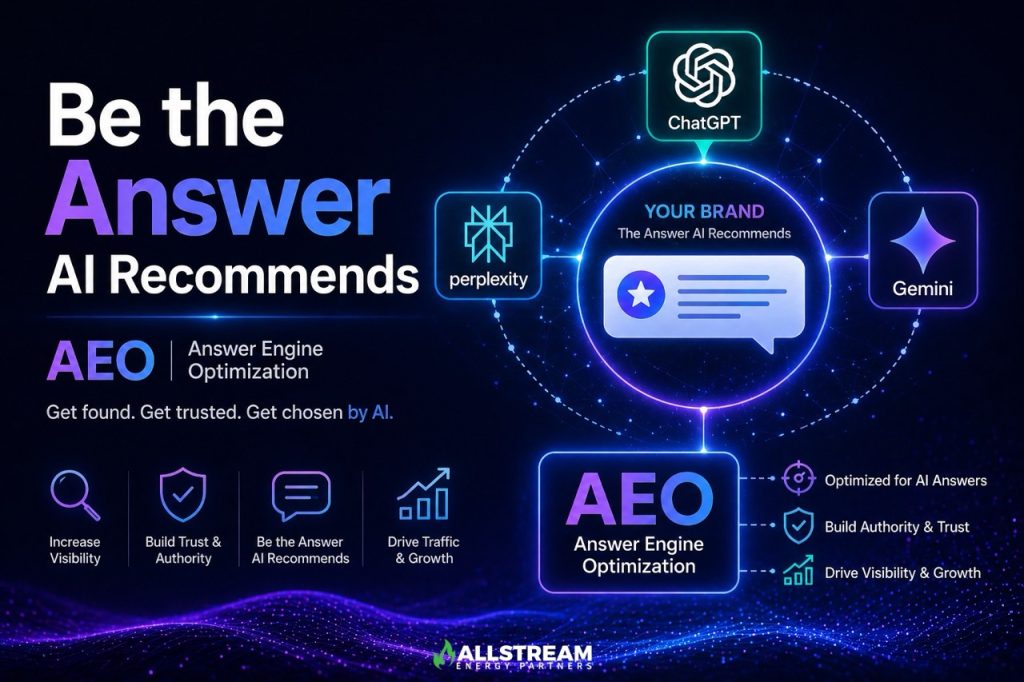
That is where Answer Engine Optimization and Generative Engine Optimization become essential.
- Answer Engine Optimization, or AEO, organizes content around the natural-language questions buyers ask and provides direct, accurate answers.
- Generative Engine Optimization, or GEO, strengthens the signals that help generative AI systems understand a company’s expertise, offerings, applications, locations, and authority.
Together, SEO, AEO, and GEO help a company remain visible across both traditional search and the emerging answer economy.
What Makes a Website AI-Optimized?
An AI-optimized website is not created by adding a chatbot or publishing large volumes of AI-generated copy.
It begins with clarity, structure, accuracy, and demonstrated expertise.
The strongest foundations include:
- Detailed product and service pages written in the language of the industry
- Clear explanations of applications, use cases, assets, and operating environments
- Structured website architecture and intentional internal linking
- Consistent company, brand, location, and leadership information
- Case studies, project examples, FAQs, technical articles, and expert commentary
- Structured data and other machine-readable signals where appropriate
- Fresh, fact-based content that reinforces real subject-matter authority
For oil and gas companies, industry knowledge is critical.
A generalist can make a website attractive. But accurately describing pipeline integrity, mechanical integrity, nondestructive testing, rotating equipment, EPC services, LNG infrastructure, valves, terminals, or process technologies requires an understanding of how the industry works and how its buyers speak.
AI systems can only work with the evidence available to them.
Vague content produces vague understanding. Clear technical content creates a stronger opportunity to be recognized as relevant.
The New Question for the C-Suite
For years, leadership teams asked:
Does our website look professional?
Then the question became:
Can customers find us on Google?
The next question is:
Can AI understand our expertise well enough to include us in the answer?
That question affects more than marketing. It touches business development, sales, recruiting, investor perception, channel partnerships, and long-term brand authority.
If AI becomes the first layer of research, every incomplete service page, outdated capability statement, missing case study, inconsistent company description, and poorly structured piece of content can weaken the digital case for your business.
The B2AI Advantage Is Being Built Now
The companies that win in AI search will not necessarily be the largest or the loudest.
They will be the companies that make their expertise easiest to understand, verify, summarize, and trust.
A year after introducing the B2AI concept, my conviction is stronger: AI is becoming a new gateway to the oil and gas buyer.
Your company must communicate with the human decision-maker, but it must also supply the AI intermediary with enough credible evidence to recognize that you may be the answer.
This does not mean chasing every new platform or abandoning proven relationship-based selling.
It means building a durable digital foundation that works for people, search engines, and AI systems at the same time.
At Allstream Energy Partners, we have been tracking this transition closely.
We combine more than 54 years of oil and gas experience paired with AI-optimized website development, SEO, AEO, GEO, media, and technical content strategy.
We understand that credibility in this industry cannot be manufactured with generic copy. It must be demonstrated through accurate language, relevant experience, useful information, and a digital presence aligned with how buyers now research.
The future of oil and gas marketing is not only B2B.
It is B2AI2B: Business to AI to Business.
The AI summarizes first. The buyer decides next. Make sure your company is part of the answer.
Continue Reading
Is your company’s website ready for AI-powered search? Visit Allstream Energy Partners to start the conversation.
Published by Allstream Energy Partners, Efrain Garcia – CEO & Publisher of Allstream Insiders