
Table of Contents
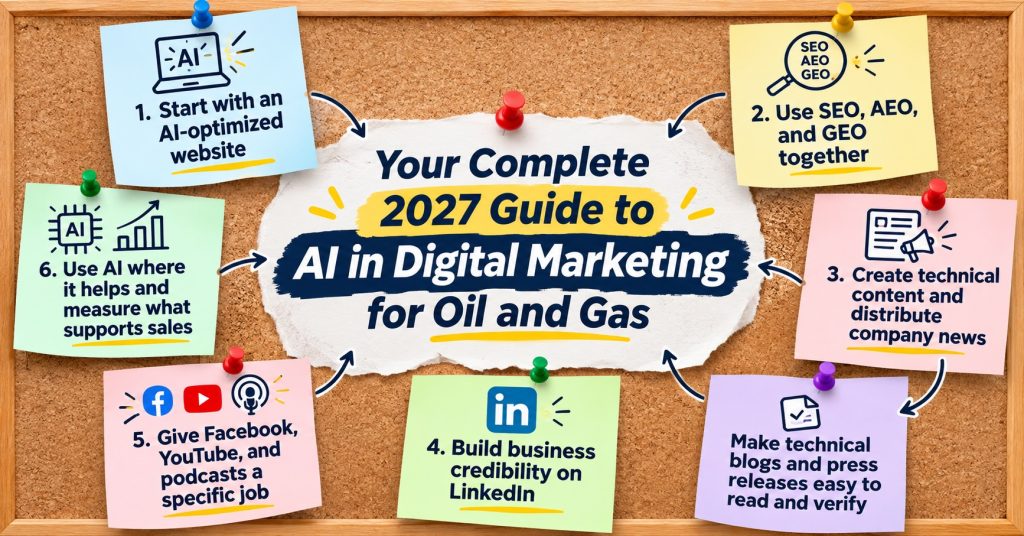
Toggle1. Start with an AI-optimized website
Your website should answer the questions that come up before a buyer calls. What equipment or services do you provide? Which applications and operating conditions do you support? Where can you mobilize? What project experience can you show? Can an engineer find a specification or can a buyer submit an RFQ without hunting for it?
Give your priority products and services dedicated pages. Publish key specifications and application details in readable page text, with downloadable data sheets for buyers who need them. Use descriptive headings, internal links, and structured data where appropriate. Add approved project examples and give every priority page a clear next step. That gives buyers useful information and gives search engines and eligible AI crawlers content they can access and interpret. Explore Allstream’s AI-ready website design services.
Allstream’s B2A, or Business to Agent, approach builds on the idea we introduced in our article on the B2AI advantage. A buyer can ask an AI assistant to compare suppliers against several requirements at once. For example, “Which suppliers provide modular gas processing equipment for midstream facilities, and what inlet conditions can they handle?” A service page that explains the process, supported operating ranges, and relevant project experience gives the assistant specific information to draw on and gives the engineer a source to verify. Read Allstream’s B2A article.
Thales’ 2026 Bad Bot Report found that automated traffic accounted for more than 53% of web traffic in 2025, up from 51% in 2024. For marketers, the practical step is to check whether the search and AI systems you intend to reach can access your public content, then measure buyer engagement and qualified inquiries separately.
2. Use SEO, AEO, and GEO together
Search engine optimization (SEO) helps your pages appear for relevant searches. Answer engine optimization (AEO) makes direct answers to buyer questions easier to find. Generative engine optimization (GEO) helps AI search systems understand your company and identify information they can reference in generated answers. A well-built technical page can serve all three purposes.
In oil and gas, an operator may define the need, an engineering, procurement, and construction firm may write the specification, procurement may qualify bidders, and a distributor or integrator may supply the equipment. Each needs different information. An engineer evaluating gas processing equipment may need operating limits and process selection criteria. Procurement may need documentation and aftermarket support details. A project manager may need to see how the unit fits into a modular installation. Build your search strategy around those decisions.
3. Create technical content and distribute company news
Technical content creation starts with the questions buyers ask before they send an RFQ. For a gas processing equipment supplier, that might mean publishing an engineer-reviewed guide to equipment selection, a case study showing how a modular unit fit into an existing facility, or an FAQ on operating limits and aftermarket support. Marketing can interview the engineer who designed the system or the field team that commissioned it, then turn their firsthand knowledge into content buyers can use and AI search systems can reference.
Press release writing and distribution help timely company news reach the industry. A contract award, facility expansion, product launch, or executive appointment gives customers and trade publications a reason to pay attention. A strong release explains what happened, why it matters, and where readers can learn more. Tailor distribution to the announcement, whether that means a newswire, outreach to relevant trade publications, or coverage through Allstream’s owned media network.
Make technical blogs and press releases easy to read and verify
- Write key facts as semantic triples. Use a clear subject, a relationship, and an object. For example, “A major midstream gas processing OEM awarded an SEO agreement to Allstream Energy Partners.” A second sentence can state what the agreement covers. Naming the companies, products, or projects involved makes each fact easier for readers to follow and gives crawlers and AI systems clearer relationships to interpret. Use this structure for the facts you want readers to take away.
- Lead with a brief executive summary. In a technical blog, summarize the buyer’s question, the main answer, and any operating condition that affects the answer. In a press release, use the subheadline or opening paragraph to state who did what and why it matters. Readers can get the point quickly and find the supporting detail below.
- Show experience, expertise, authoritativeness, and trustworthiness (E-E-A-T). Name the author and technical reviewer where appropriate. Show relevant field experience through approved project examples, cite applicable standards or source documents, and state the conditions and limitations behind performance claims. For a press release, verify names, dates, and figures, and attribute quotes to named spokespeople.
Allstream put both services to work in 2026 when a major midstream gas processing OEM awarded us an SEO agreement covering technical content development, AEO, and GEO. The public announcement explained the award and its scope. The work itself focuses on turning the OEM’s technical expertise into information buyers and AI platforms can find and use. Read the gas processing OEM agreement announcement.
Allstream interviews subject-matter experts, develops technical articles and case studies, and writes and distributes press releases. As both an energy marketing agency and the publisher of Allstream Insiders, we can help relevant announcements reach readers across the energy industry. Explore Allstream Insiders.
4. Build business credibility on LinkedIn
Give prospects a reason to trust the people behind your capabilities. Keep the company page and leadership profiles current. Share project milestones approved for release. Let engineers, operations leaders, and executives explain what went into a decision or what they learned in the field.
For example, a reliability leader could explain which inspection findings changed the scope of a turnaround and how the team responded. That gives prospective customers something substantive to discuss and gives your sales team a credible resource to share before a meeting.
Choose the LinkedIn format based on what your audience needs next. A short post can share one useful takeaway. When the topic calls for a live discussion, ongoing coverage, or a deeper explanation, use a format that gives it room:
- Create a LinkedIn Event when you have a specific date and a reason for people to attend, such as a technical webinar, equipment demonstration, or conference panel with a live Q&A.
- Launch a LinkedIn newsletter when you have a recurring topic and can publish consistently. A monthly series on turnaround readiness or pipeline integrity can give subscribers practical insights between projects and buying cycles.
- Publish a long-form LinkedIn article when a topic needs more context than a short post can provide. An engineer could walk through an equipment selection decision, explain the trade-offs, and link to a detailed guide or case study on your website.
Allstream Energy Partners helps oil and gas companies decide when to use each format and supports the work through LinkedIn management, executive thought leadership, and technical content development.
5. Give Facebook, YouTube, and podcasts a specific job
| Channel | What it can do for an oil and gas company | What to publish |
|---|---|---|
| Build familiarity with field teams, local communities, trade associations, and prospective employees. | Crew milestones, training highlights, community involvement, recruiting posts, and industry event coverage. | |
| YouTube | Show equipment and processes in action so buyers can see how they work. | Product demonstrations, approved field footage, equipment walk-throughs, and engineer-led explainers with captions and links to relevant service pages. |
| Podcasts | Give technical and commercial leaders time to explain the decisions behind a project, product, or industry trend. | Executive interviews, conference conversations, and technical discussions supported by show notes, transcripts, and short clips. |
One conversation with a gas processing engineer can become a website FAQ on equipment selection, a LinkedIn post on project trade-offs, a YouTube walk-through, and a longer podcast episode. A Facebook post can introduce the crew behind the project. The expertise stays consistent while the format and emphasis serve each audience. Allstream does this work across social media, video, and podcasts, including through ALLSTREAM●ING – Inside the Energy Industry. Listen to ALLSTREAM●ING.
6. Use AI where it helps and measure what supports sales
Use AI to organize the questions your sales team hears, identify gaps in existing content, turn an approved interview into draft FAQs, or find clips in a long recording. Have a subject-matter expert check operating ranges, standards references, performance claims, and project details before publishing.
Start with one priority service line and track how buyers find and evaluate it. Review Google visibility and AI mentions for a consistent set of buyer questions. Track visits to priority service pages, qualified RFQs, and sales conversations tied to the campaign. Ask prospects where they first heard about you and what they reviewed before reaching out. That feedback helps you decide where to invest next.
Why partner with award-winning Allstream Energy Partners?
Fast Company recognized Houston-based Allstream Energy Partners in two categories of its global 2026 Best Workplaces for Innovators program. Allstream was one of 20 honorees for AI, Automation, and Machine Learning Excellence and one of eight honorees in Advertising, Marketing, and PR. See Fast Company’s AI, Automation, and Machine Learning Excellence list and its Advertising, Marketing, and PR list.
For an oil and gas supplier, the advantage is having one partner that understands the technical sale and can carry the strategy through. Allstream can build the AI-optimized website, interview your subject-matter experts, create technical content, run SEO, AEO, and GEO, write and distribute press releases, manage LinkedIn and Facebook, and produce video and podcasts. Our owned media, industry calendars, and executive events give those efforts additional reach across the energy supply chain.
Our founders bring more than 54 years of combined experience across oil and gas and energy-focused digital marketing. We also developed Allstream GRID, our Generative Retrieval Intelligence Diagnostic, to help assess AI search visibility. Read Allstream’s Fast Company award announcement.
Be the answer AI recommends. Give buyers the evidence to put you on the shortlist. Let’s start with the products or services you want to grow in 2027 and the questions customers ask before they call. Talk with Allstream Energy Partners.